

I bought Pure Encapsulations Magnesium Glycinate in March, along with four other bottles, and I have taken one capsule every evening since. That is not a testimonial. It is a line in my supper routine, and it is the least interesting thing I could tell you about this product.
Here is the more useful version. I spent twenty-six years running a school cafeteria kitchen in Conway, Arkansas, and most of that job was reading the back of a package before I served what was inside it. About four hundred lunches a day, and I checked the label on every case that came through the door. I read the magnesium shelf the same way earlier this year. What I found is that the front of the bottle tells you almost nothing, the back tells you a great deal, and neither one tells you how the thing will feel. So this is the honest accounting: what the label says, what I noticed, what I did not, and the parts a person standing in the pharmacy aisle deserves to know before ordering five bottles at once the way I did.
The Quick Verdict
A plain label, one capsule at supper, and a bottle small enough to disappear onto the pantry shelf. It supports normal function and it fixes nothing. That is the whole review.
Amazon Check Today's Price →One capsule at supper, and a label that does not dress itself up.
Ninety capsules. Vegetarian, gluten free, unflavored. Read the back of the bottle the way I did, then check today's price on Amazon.
Amazon Check Today's Price on Amazon →What the Label Actually Says
The front is short. Magnesium (glycinate). Ninety capsules. Vegetarian, gluten free, unflavored. That is the entire sales pitch, and I mean that as a compliment. There is no banner across the front promising you anything, which already puts it ahead of most of the shelf.
The back is where a label reader earns her keep. Pure Encapsulations lists what magnesium supports: cardiometabolic, neurocognitive and musculoskeletal health. It mentions the enzymes involved in neuromuscular contractions, the metabolism of carbohydrates and amino acids, energy production, the body's use of calcium, and the metabolism and utilization of vitamin B6. Read those verbs again. Supports. Assists. Helps metabolize. Not one line claims to treat, cure or prevent anything, and that is exactly what you want on a supplement label. A bottle making bigger promises than that is telling you something about the marketing department, not the ingredients.
There is a second thing a label reader looks for, and it is not on the front either. It is the shape of the supplement facts panel. On this bottle the panel is short. One line for magnesium, a handful of lines under it, and then the usual line about the capsule itself. A short panel is a gift. You can read the whole thing standing up, without your glasses, without turning the bottle to catch the light. Some panels run the length of the back in print small enough to need the kitchen window. A short panel is easier to trust.
What the label does not tell you is anything about how it will feel, or when to take it. There is no line about evenings. There is no line about the time of day at all. Four of my five bottles are morning bottles. This one is not, and that was my decision, not the bottle's.

How It Fits Into My Day
Breakfast is at seven thirty and it is oatmeal and one slice of toast, and it has been for years. That is when the other four go down: the D3 and K2, the fish oil, the B-complex, the probiotic. Supper is at six at the kitchen table, and that is when the magnesium goes down. One capsule. A glass of water. Then the bottle goes back up.
Seven thirty at this house is four bottles, not one. The D3 and K2 softgel, two fish oil softgels, the B-complex capsule and the probiotic tablet, all in the same minute, all with the same glass of water, all before the oatmeal cools. That is a crowded ninety seconds. Adding a fifth thing to it would have meant adding a fifth thing to remember at the exact moment I am least interested in remembering anything. Putting the magnesium at six in the evening instead was not a nutrition decision. It was a scheduling one, and it is the reason the bottle is still in rotation.
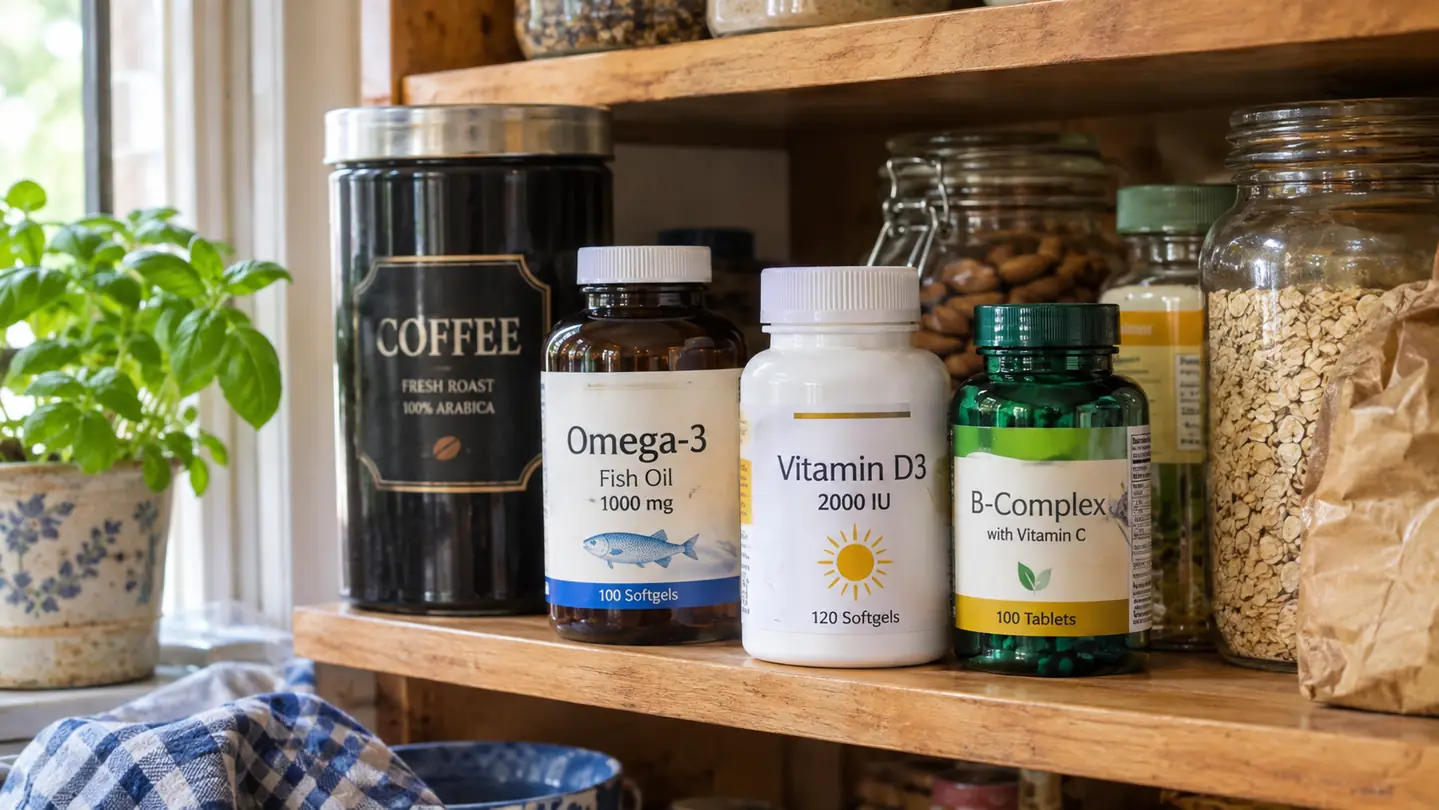
The bottle lives on the second pantry shelf beside the coffee. It comes down at supper and it goes back up after. That sounds like a small thing to write down, but it is the reason I have taken it every evening for eight months. A supplement you have to go find is a supplement you stop taking. This one is already where I am standing at six o'clock, next to the thing I reach for first every morning.
This is a one-story brick house with a small pantry, and five bottles is close to the limit of what fits on that shelf without stacking. Nothing is stacked. Nothing gets carried from room to room. The magnesium comes down at six, one capsule goes out of it, and it goes back where it was. That is the entire system, and it has held for eight months.
I started all five on the same day, Monday, March 2, 2026, from one order. I am on my third bottle of the magnesium now, and it is November as I write this. Eight months, and the routine has not moved once.
Nothing on the back of that bottle promised me an easier evening. It told me what magnesium supports and left the rest to me, my doctor and my pharmacist.
What I Noticed, and When
Around three weeks in, the evenings felt a little easier to wind down. That is the whole of it. Not a switch flipping. Not a fog lifting. Just evenings that felt easier to wind down. I noticed it because I had been taking the capsule long enough to stop thinking about it.
Could the magnesium glycinate be doing that? Maybe. Could it be something else entirely? Also maybe. I am not a doctor, a nurse or a dietitian, and I am not going to dress up a guess as a finding. I take one capsule at supper, and evenings feel easier to wind down. Both of those things are true and I cannot separate them for you.
What I did instead of guessing was write it down. Not a diary, just a line at the end of the day on the back of the grocery list pad, the same way I used to note what sold out at lunch. If you want to know whether something is doing anything for you, that pad is worth more than any review on the internet, mine included. Two months of your own handwriting beats twenty minutes of reading.
What I can tell you is what I did not notice. I did not notice anything in the morning, ever. If you are looking for something you can feel inside an hour, this is not that product and I would rather say so on page one than have you find out in week two with a bottle you now feel obligated to finish.
The Comparison I Did in the Aisle
I have never bought magnesium oxide. I want to be plain about that, because a comparison written by someone who owns both bottles is a different animal than what I can honestly give you. What I did was stand in the pharmacy aisle with two bottles in my hands and read the backs of both, the way I used to read a case of frozen chicken before signing for it.
Both bottles said magnesium. The word after magnesium was different. One said oxide, one said glycinate. That second word is the part that matters to a label reader, because it tells you what compound you are actually holding, and the front of the bottle will not explain the difference to you. It assumes you already know. Most of us do not, and a pharmacy aisle is a bad place to find that out while someone waits to get past you.
So I printed the Amazon label pages at home along with the other four and brought the pages to my yearly physical in late February. Dr. Alvarez read them and okayed them for me. Then I took the same printed pages to the counter and Dana looked them over once. That is the sum total of my expert input, and it is more than most people get. If you are going to take a supplement, go get that input. It takes one appointment and one conversation at a counter, and it beats anything you will read here, including this.
What Twenty-Six Years of Labels Taught Me
In the cafeteria I learned to read for three things: what is in it, how much of it, and what else is in the package besides the thing on the front. That habit does not turn off when you retire. It is why the Pure Encapsulations bottle appealed to me in the first place. One ingredient. No proprietary blend line. No list of nine botanicals I would have to go look up in the car.
The proprietary blend is the thing I would warn you about generally, wherever you shop. When a label lists a blend and gives you one combined number for the whole list, you cannot tell whether the first ingredient is most of it and the last one is a dusting. That is not a knock on any particular brand. It is just how those labels work, and it is why I lean toward bottles that list one thing plainly, the way this one does.
The other habit I brought home is patience with the calendar. A bottle is not a light switch. I gave this one three weeks before I formed any opinion at all, and I would give any of the five the same. If you cannot give it three weeks, it may not be the right fit.
The Parts Nobody Mentions
Ninety capsules at one a day works out to about three months per bottle. That means roughly four bottles a year, and it means you will be reordering before the bottle feels close to empty. I am on my third since March, which lines up more or less exactly.
Four bottles a year is the practical math, and it is worth setting a reminder rather than trusting memory. I know the bottle is running low when the level drops near the bottom and it rattles differently in my hand. That is the whole system. When it does, it goes on the grocery list that week, and it has never run out on me. It is a small habit, and it beats discovering an empty bottle at six in the evening.
It is a capsule, not a tablet, and it is vegetarian and gluten free. Unflavored, so there is nothing to taste and nothing to chase with juice. I take it with water and I genuinely could not tell you what it tastes like, which is the highest compliment I can pay a capsule at six in the evening.
There is also the matter of the capsule itself. It is a capsule and not a tablet, and at fifty-eight that matters more than it did at forty. A big tablet is a negotiation every evening. This one from Pure Encapsulations goes down with a swallow of water and no second attempt. I am not going to turn that into a rule for anyone else, because I have known people who prefer tablets and people who cannot take a capsule at all, and both are entitled. But if you find powders a chore, a capsule is the easier shape.
The bottle is small. Just under four inches tall, about two and a quarter inches across, and under five ounces. It sits on the pantry shelf beside the coffee without me moving anything else and it disappears into the row. If you are expecting a big tub, you will be surprised by the box on the porch. That is worth knowing before you order rather than after.
And there is no ceremony to it. No powder to mix, no scoop, no shaker bottle to rinse. One capsule, one glass of water, one trip back to the pantry shelf. At my age the routine that survives is the one with the fewest steps in it.
What I Liked
- One ingredient on the label, so there is nothing to decode
- Capsule form, vegetarian, gluten free and unflavored
- Ninety capsules at one a day comes out to about three months
- The bottle is just under four inches tall and fits on a pantry shelf without rearranging anything
- Easy to keep, because six in the evening is already a habit in this house
Where It Falls Short
- The front of the bottle tells you almost nothing; everything useful is on the back
- Nothing on the label says when to take it, so the evening slot is your call
- It is a single ingredient and covers nothing else on your list
- You will not notice anything in the first week, and most people quit before week three
Who This Is For
This is for someone who wants one plain thing at the end of the day and is willing to give it a few weeks before deciding anything. It suits a person who already reads labels, or who wants to start, because there is not much on this one to work through. One ingredient, one capsule, one line on the back explaining what magnesium supports. The capsule from Pure Encapsulations is vegetarian and gluten free, unflavored, and small enough that a person who dreads the horse pills has nothing to dread here.
It also suits anyone whose mornings are already crowded. Four of my five go down at breakfast and that block is full. If your morning is spoken for and your evening is quiet, the magnesium slot slides in without disturbing anything.
Who Should Skip It
Skip it if you need to feel something. One capsule at supper is not a product you notice in the first week, and if you are the sort of person who gives up on day four because nothing happened, you will have a nearly full bottle on your shelf and a sour feeling about it.
Skip it if you take prescription medication and have not asked your pharmacist. Magnesium is not nothing, interactions are real, and your pharmacist is the person to ask. Ask yours. Check with your doctor too, the same way I brought my printed pages to Dr. Alvarez before a single bottle arrived. And skip it if you want a combination product, because this is one ingredient and it is not going to cover anything else on your list.
Eight months, three bottles, one plain label.
If your mornings are full and your evenings are not, this is the easiest slot to keep. Read the back of the bottle first, then check today's price on Amazon.
Amazon Check Today's Price on Amazon →