
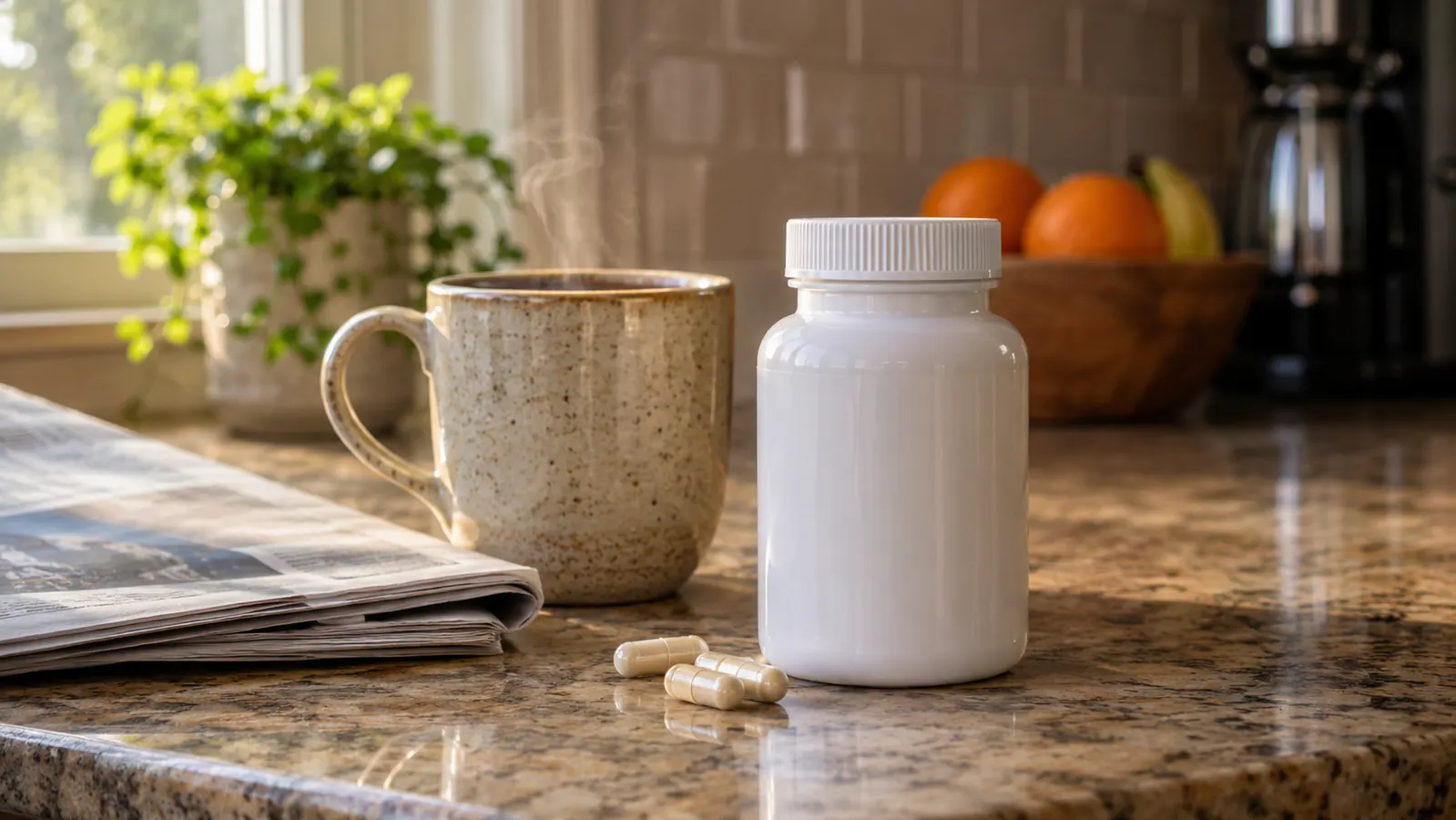
I spent twenty-six years reading labels in a school cafeteria, about four hundred lunches a day, so the habit did not retire when I did. I read the back of a box before I read the front, and I still do. When vitamin D3 and K2 came up as one of my basics, I judged it the same way I used to judge a case of frozen vegetables: I read the back. The one I landed on was Sports Research Vitamin D3 + K2, and I have taken it every morning since March. What I want to show you here is the reading, not the bottle.
A D3 and K2 label is short. Four or five lines and a footnote. That short length is exactly why people skim it. A long ingredient list looks like it deserves attention, and a short one looks like there is nothing to check. The opposite is true. Every line on a short panel is carrying weight, and one of those lines is the dose you are actually going to take.
The shortest label I have read in years, and the one I still check
Sixty plantgels, one a day. Vegan D3 from lichen at 125 mcg, K2 as MK-7 at 100 mcg, in coconut oil. That is the whole panel, and it is worth reading twice before you decide anything.
Amazon See the Sports Research D3 + K2 label on Amazon →Step 1: Find the D3 amount and learn to read both numbers
The first line to find is the vitamin D line, and it will usually give you two numbers that mean the same thing. On this panel it reads 125 mcg, which is 5000 IU. Micrograms and international units are two ways of writing one dose. A label that gives you both is simply easier to compare against the next bottle, and comparing is the whole reason you are reading.
Two bottles can stand side by side with the same friendly front and the same size capsule, and one prints 125 mcg while the other prints a much smaller number. In an aisle, with the light coming down and someone waiting on you, that is exactly when your eye slides off the figure. So I read the dose out loud, quietly, and then I read the serving size out loud too. Two sentences, five seconds, and you know what one dose actually is. I have never bought or tried a second D3 product, so everything I know about the others comes from standing in the pharmacy aisle reading their panels, not from swallowing them.
That number is the one that matters most in your hand. 5000 IU is a high daily dose. It is not a middle-of-the-road amount, and it is not something to add to a routine because a bottle looked good on a screen. I asked Dr. Alvarez about that exact number at my yearly physical in late February, and she okayed it for me specifically. Yours may be different. The only person who can answer that for you is your own doctor or pharmacist, and that is not a thing I can do for you.
While you are on this line, check the serving size. Here it is one softgel, so 125 mcg is what one gives you, not two or three. Plenty of panels list a big number that turns out to be a two-capsule serving, and people take one and believe they got the whole thing. One line, one number, one softgel. Good.

Step 2: Check the form of the D3 and where it came from
Right after the amount, look at the form. This one says cholecalciferol, which is D3. That is the word to look for, because D2 prints as ergocalciferol and it is a different item on the panel. You do not have to remember any chemistry. You just have to notice which word is sitting there.
Then look for where it came from, which a serious label spells out. The Sports Research version gets its D3 from lichen, and the panel says so. That is also why the bottle says plantgel and why the diet type line reads vegan. If you keep a vegan or vegetarian kitchen, that line is the reason you are reading this panel instead of a different one.
There is a second thing the form line tells you. When a panel is this short, every word is load-bearing, and the words run in the order they sit inside the softgel. You do not have to hunt down a sub-list or decode a blend. Five lines, top to bottom, and you are done. That is the only reason I trust myself to read it every time I open a new bottle instead of reading the first one carefully and never again.
If you do not keep a vegan kitchen, the line still tells you something. A manufacturer who names a source expects you to ask about it. I notice that the same way I noticed it on food packaging for twenty-six years, and it is the kind of small sign that separates a label you can work with from one that just makes noise.
Step 3: Read the K2 line instead of stopping at the D3
Most people stop reading once they find the D they came for. Do not. The second half of the name on the front of the bottle is on the panel too, and it has its own number. Here it is 100 mcg of K2, printed as MK-7.
In the aisle I read the K2 line differently from the D line. Some panels print a number and stop, leaving you to guess which form they mean. This one names MK-7, and the listing calls that the most bioavailable form, which is the sort of line a label reader should read once and then set aside rather than memorize. What I take from it is simpler: the form is named, not hidden. A panel that hides the form is asking you to buy the front of the bottle, not the back.
K2 is the part that made me choose this bottle over a plain D3. The two are usually discussed together because they work on the same job, which the listing describes as supporting strong bones and normal calcium use. Notice the word support. That is the correct word, and I use it on purpose. What I can tell you honestly is that after eight months I feel nothing from this bottle at all. Nothing good, nothing bad. I take it because the panel made sense to me and my doctor approved that dose.
There is one caution on this line worth repeating. K2 matters for anyone on a blood thinner, so if that is you, ask before you buy, not after. Dana at my pharmacy counter looked over the printed pages with me before I ordered anything. That is a five-minute habit I would keep whether you take one supplement or five, and it takes one short conversation.
One softgel, 125 mcg of D3 from lichen, 100 mcg of K2 as MK-7, in coconut oil. That is the whole product, and it is all on the panel.

Step 4: Look at what carries the vitamins
The next line down is the one people skip entirely, and it is the carrier. This label says coconut oil. The vitamins sit in the oil rather than being pressed into a dry tablet, which is why the item form reads softgel and why the listing calls it easy to swallow. It is also why the bottle is small, about two inches square and under four inches tall, weighing a little over an ounce.
The softgel itself is thin and smooth, a shell around oil rather than a pressed tablet, and the listing calls it easy to swallow. I take mine with the water glass I already have at breakfast. Nothing to chew, nothing to break in half. That detail matters more at fifty-eight than it did at thirty, and it is printed on the form line, not in the advertising.
The rest of the small print is short. Unflavored. Gluten free on the allergen line. No long list of extras to decode. Whether that matters depends on what you are avoiding, but you cannot know unless you read past the first number and down to the bottom of the panel.
Here is how that looks at my house. The bottle lives on the second pantry shelf beside the coffee, because that is where I will see it at 7:30 in the morning with my oatmeal and toast. One softgel, then the other three breakfast bottles, then everything back on the shelf. A label you cannot find at the right moment is a label you wasted your time reading. Where you keep the bottle is part of reading it.
Step 5: Read what the panel does not say
This is the step I would put first if I could, and it is the one nobody teaches. After you read what is there, read what is missing. Is there a K2 line at all, or only D3? Is the serving size one or two? Does the panel name a source, or just print a number? Does it give you both units so you can compare it to the bottle beside it? A blank space on a label is information.
A blank takes different shapes. Some panels never name the K2 form. Some print the D amount in IU only, so you are doing arithmetic on your phone in a cold aisle. Some tuck a two-capsule serving into small type at the bottom. Some have no source line at all, so you cannot tell whether the D came from lichen or from lanolin. Each of those blanks is a question you would want answered before the bottle comes home, not after.
The front of the bottle will use words like immune support, and the listing here does the same, along with a note about muscle. Read those the way I read a cafeteria menu board: as a description of what the product is for, not a promise about what will happen to you. Supplements support normal function. They do not treat, cure or prevent any disease, and a label that hints otherwise is a label to put back down.
Last, read the count and do the quiet arithmetic. Sixty plantgels at one a day is two months in one bottle, which tells you how often you will be reordering. The listing shows 4.8 stars across more than 56,000 ratings. That tells you people keep buying it. It does not tell you what is in it. Only the panel does that.
What Else Helps
Print the pages and take them with you. I printed the label pages for all five bottles I was considering and brought them to my physical in February. Dr. Alvarez read them at that visit, and then I brought the same pages to Dana at the counter. Neither visit had a bottle in it. Both were paper, and both told me more than the front of any bottle.
A paper clip and a pen are enough. I keep my printed pages clipped together in the folder where the bills go, and I wrote the dose on the top corner of the D3 page so I would not have to re-read it standing up. If you would rather not keep paper, take a photo of the whole panel with your phone, the entire back in one frame, not just the front. The front is the part you will remember anyway.
Compare two labels side by side instead of from memory. The difference between a bottle with K2 and one without is a single line, and a single line is easy to lose between aisle one and aisle two. Stand still and hold both. Reading is not a race.
And keep the whole business small. My routine is five bottles, and the D3 with K2 is one softgel of it at breakfast; Sports Research is the one I settled on and have taken for eight months. I am not a doctor, a nurse or a dietitian, and I am not going to pretend to be one on a page. I am a retired cafeteria manager who reads the back of things. The most useful habit I can pass along is simple: turn the bottle over before you decide.
Read the panel one more time, then decide
One softgel a day, 60 in the bottle, vegan D3 from lichen and K2 as MK-7 in coconut oil. If those numbers match what your doctor approved for you, that is the whole decision.
Amazon Check Today's Price on Amazon →