
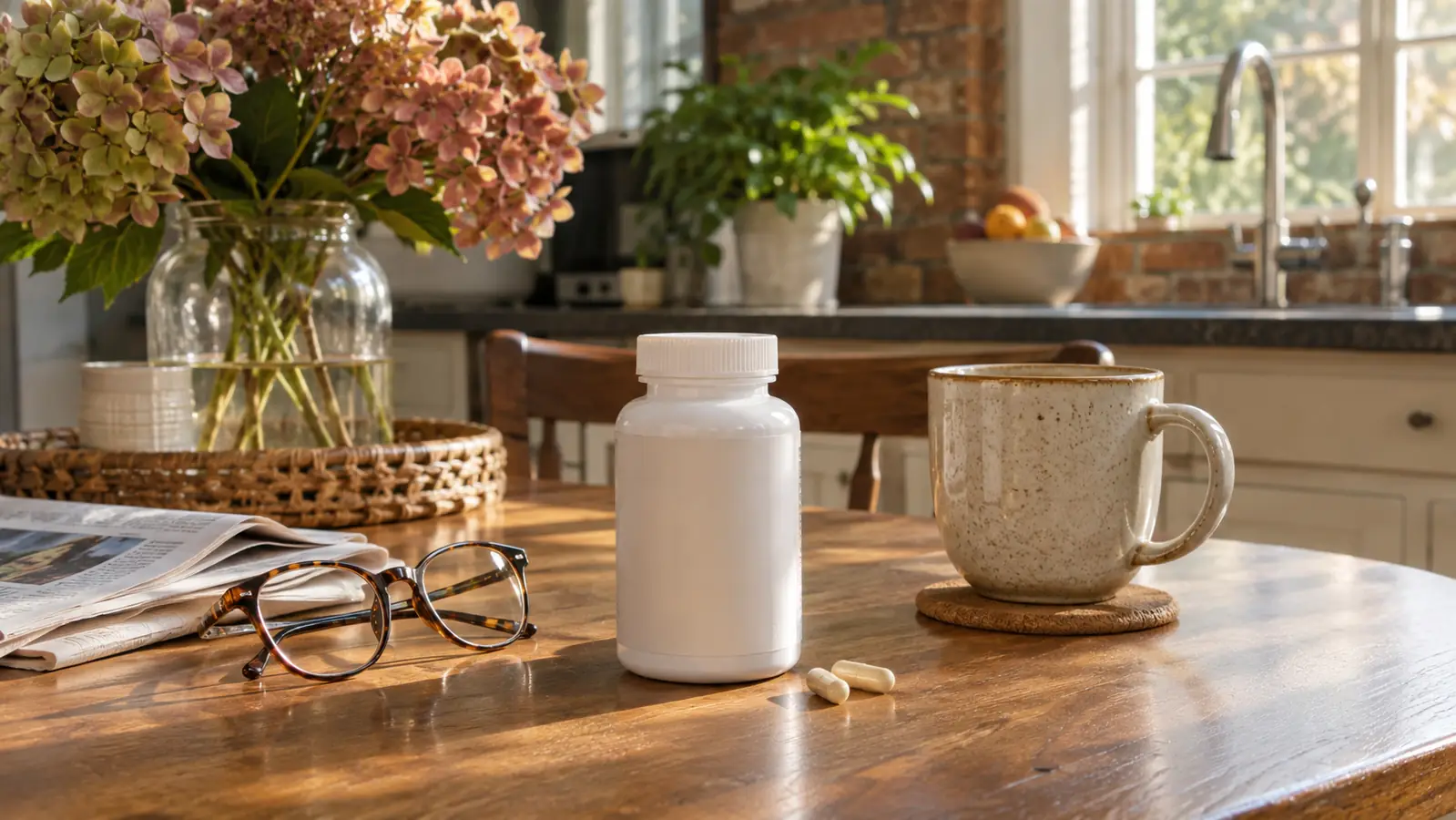
I spent twenty-six years reading ingredient labels for a living. One elementary school cafeteria in Conway, Arkansas, about four hundred lunches a day, and every box that came through the back door got turned over in my hand so I could read the panel before it went on a shelf. I retired in June 2024 and I kept the habit. So when a probiotic came up as one of my five basics, I printed the label pages, sat down at the kitchen table, and read them the way I used to read a case of frozen peas.
A probiotic label is not difficult. It is written in a vocabulary nobody hands you. Colony forming units. Active cultures. Strains. Delayed release. The words look important, and the numbers that actually decide whether a bottle fits you get printed small enough to walk right past. I read labels for a living for a quarter of a century and I still had to slow down and go line by line.
The bottle I take is Nature's Bounty Probiotic Acidophilus, 120 tablets, one a day, and I have been on it since Monday, March 2, 2026. I am not a doctor, a nurse or a dietitian. I am a retired cafeteria manager who reads the panel. What follows is how I read a probiotic label now, and what I found on this one when I did.
The label I was still reading eight months later
Nature's Bounty Probiotic Acidophilus is 120 tablets, one a day, with 100 million active cultures. That count is small next to most of the shelf and I say so plainly further down.
Amazon Check Today's Price on Amazon →Five Things I Check on Any Probiotic Label
None of the five take more than a minute. The whole list takes less time than finding the aisle.
Step 1: Find the Culture Count and Read the Unit That Follows It
Every probiotic prints a number, and that number is what people compare. What most people skip is the unit sitting right after it. Mine reads 100 million active cultures. Not billion. Million. A much smaller number than many bottles print, and that was the most useful thing I learned from reading this panel.
A count is not a score. It is the amount in the tablet at the time it was made, and a bigger number is not automatically better for you, any more than a bigger dose of anything is. What the count gives you is something to compare. Line up three bottles, see two say billion and one say million, and now you know the difference exists and can decide whether it matters for what you want. I decided it did not matter for a daily basic in my own routine. That is my judgment about my own shelf, not a rule for yours.
So write the number down, unit and all, before you read anything else on the panel. It anchors every comparison you make after it, and it keeps you from doing the thing I have watched people do, which is compare a one tablet serving against a two capsule serving and call it a fair fight.
Step 2: Match the Serving Size to the Count in the Bottle
Next I look at how many tablets make a serving, then how many are in the container. A label can be completely honest here and still catch you out, and it is not the manufacturer's fault, it is arithmetic. A bottle of 120 tablets with a serving of two is a sixty day bottle. Not a hundred and twenty day bottle. Same bottle, same label, half the supply you assumed.
The Nature's Bounty bottle reads one tablet a day with 120 tablets in the container, so there is nothing to divide. That works out to four months of a single habit, and I check this before anything else because it decides whether the bottle fits into a morning at all. One tablet at breakfast is a habit I can keep. Two at breakfast and two at supper is a schedule, and I know exactly how I am with schedules.
While I am on this part of the label I look for the directions line, which usually sits under the panel in the smallest print on the bottle. If it asks for food, or an empty stomach, or a particular time of day, I want to know that on the day I buy, not the day I open. My breakfast is oatmeal and one slice of toast, every day, and has been for years, so anything built around a meal is easy for me and anything built around an empty stomach is not.
Step 3: Read the Other Ingredients Line, Not Just the Active Ones
This is the line I spent twenty-six years reading on food, and it is the line I trust least on a supplement. The other ingredients list is where binders, fillers, coatings and sweeteners live, printed below the supplement facts panel in the smallest font on the bottle. The panel on the bottle I take says gluten free and unflavored, and I read both of those as the absence of something, which is exactly what I want in a tablet I swallow with oatmeal at 7:30 in the morning.
I look for two things on that line. First, whether I recognize the words. Second, how long the list runs. I am not a chemist and I do not pretend to judge every binder by name, so I use length as a rough filter. A short list of words I can pronounce gets a second look. A long list where the tail end is flavors and colors goes back on the shelf, and I do not feel bad about it.
One practical note. If a label stays silent on gluten and you avoid gluten, that silence is your answer. Two words on the panel saved me from having to guess, and that is the standard I hold any label to: say it, or I assume it is not there.
Step 4: Find the Strain Name and Check That It Is Actually Printed
Here is where a lot of bottles get vague. A line that says probiotic blend with a number after it tells you how much, not what. A strain name is the genus and the species, printed in the panel or under the count. The bottle I take names Lactobacillus acidophilus on the front, and the panel lists acidophilus as the special ingredient. That is a specific organism with a name I can write down and hand to somebody who knows more than I do.
I did exactly that. At my yearly physical in late February 2026 I brought printed pages of all five supplements I was considering to Dr. Alvarez and asked her which basics made sense at my age. She read the pages and okayed them. I showed those same printed pages to Dana at the pharmacy counter afterward. Neither of them saw a bottle, because I had not bought one yet. That order is the one I would recommend to anybody: names in hand, question asked, bottle bought after.
If a bottle will not tell you which organism is inside it, that is information too. The front of mine mentions fifty years of research, and I read that as a marketing line rather than proof of anything. The strain name is the part I can actually check, so the strain name is the part I care about.
100 million is smaller than most of the shelf. The label says so plainly, and plain is what I want on a panel.
Step 5: Check the Form and Ask Whether You Will Actually Take It
I look at the form last, on purpose. Tablet, capsule, softgel, powder, chewable. The bottle I buy is a tablet, unflavored, one a day, and it goes down with the rest of my breakfast at 7:30 with no fuss at all. That is the whole reason it works for me. A perfect panel on a form I dread taking is a bottle that sits in the pantry until it expires.
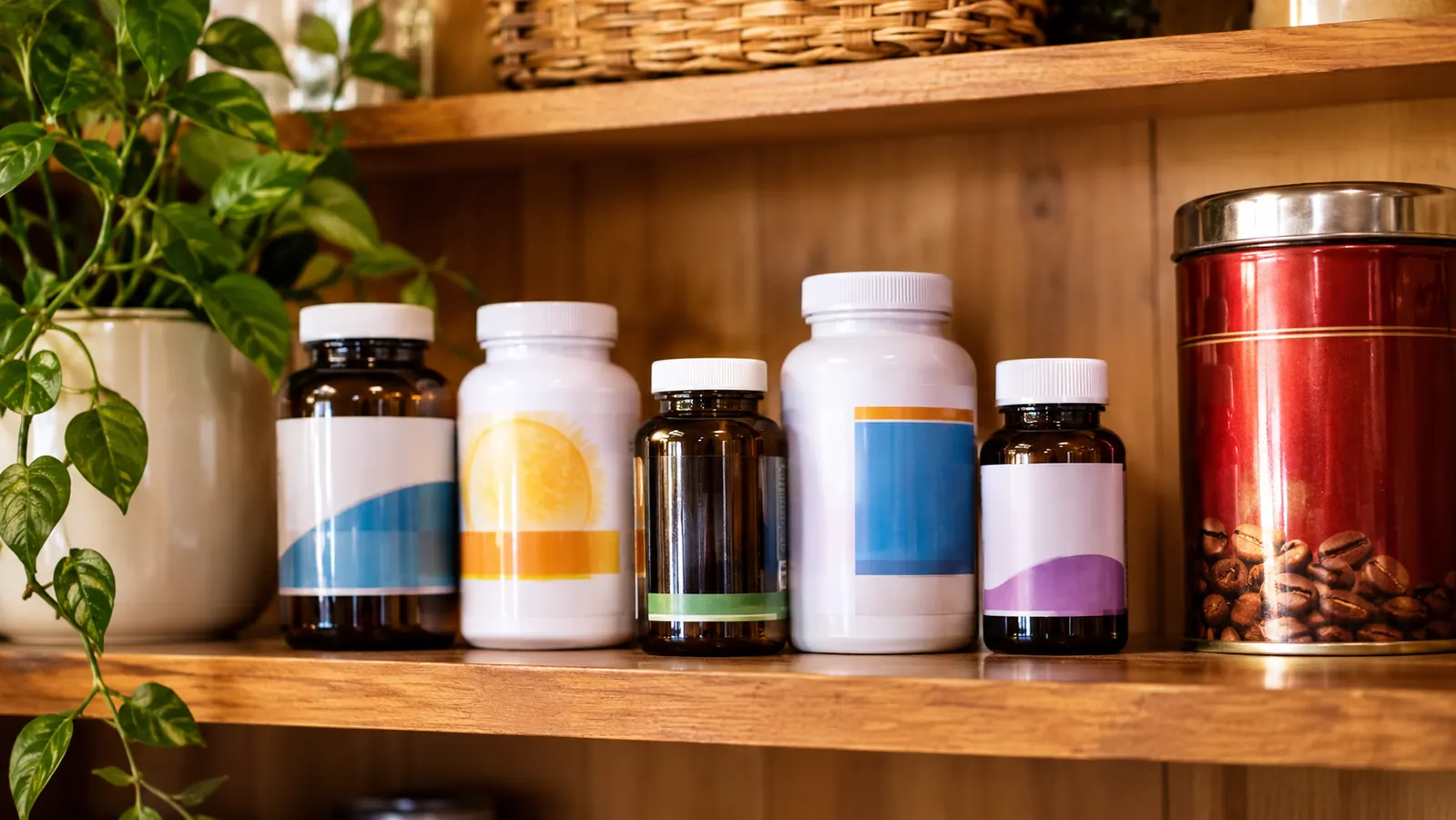
Form also decides storage, and storage is the part nobody reads. All five of my bottles stay on the second pantry shelf beside the coffee, and I take them down at the meal and put them back. If a label asks for something my pantry shelf cannot give it, I want to know that before the bottle comes home rather than after.
And one honest note about this one. 100 million active cultures is a small count, and I knew that when I ordered it. I am still taking it eight months later, one tablet at breakfast alongside three other bottles. A smaller count on a simple one tablet serving was the trade I picked for a daily basic. That was my call for my own routine. It is not advice about yours.
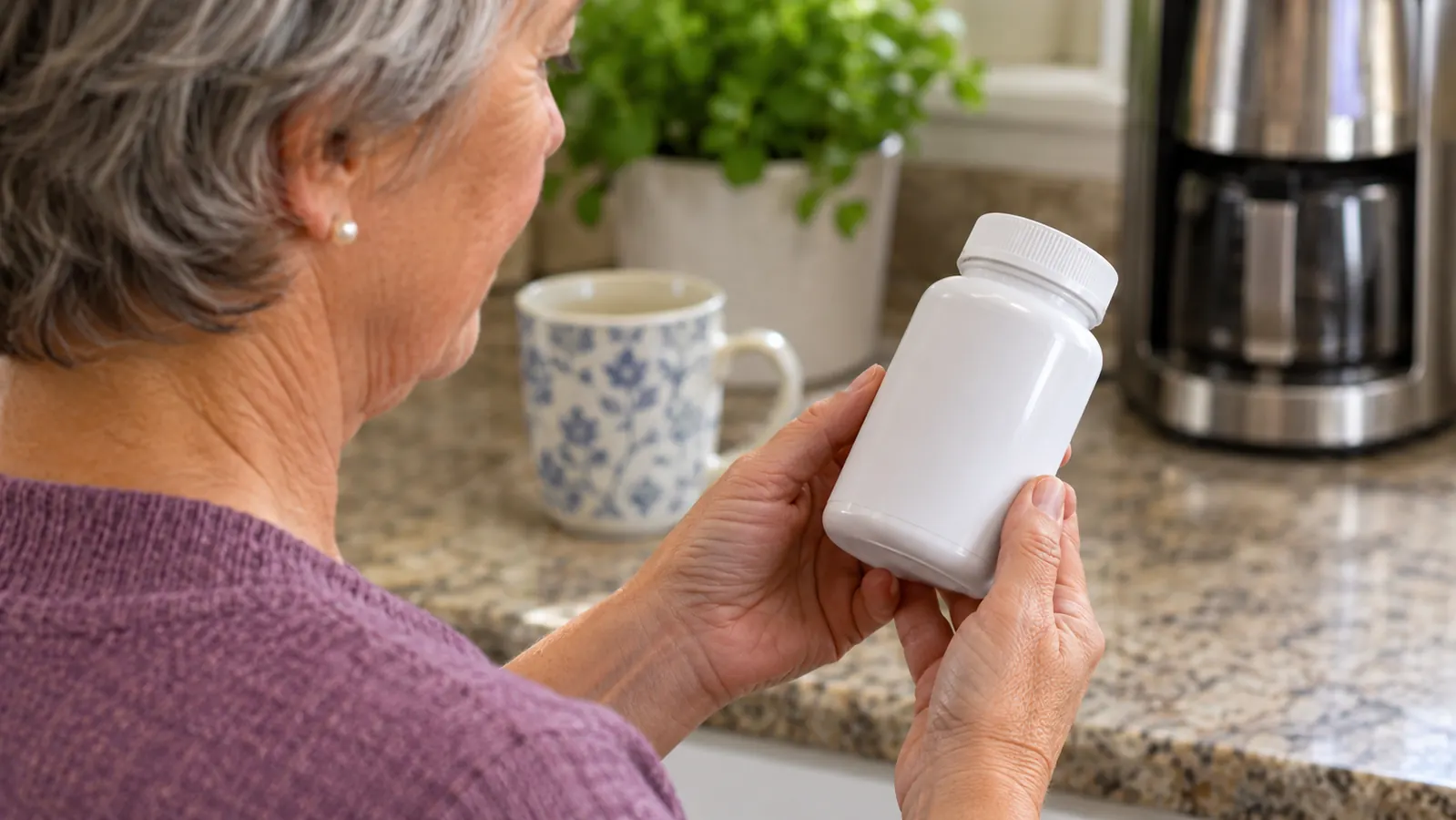
If You Only Have Thirty Seconds in the Aisle
Then read three numbers. The count, the unit, and the serving size. Those are printed on every panel and they answer most of the question. 100 million and one tablet a day is a very different bottle from 50 billion and two capsules a day, even when the front of the box looks almost identical.
Everything else, the strain name, the other ingredients, the form, is worth the extra minute, but only after those three. I have watched people stand in an aisle reading the front of a box for five minutes and never turn it over. The front is written to be read. The back is written to be checked.
What Else Helps
Reading the panel is the part you control. The rest is asking. I asked Dr. Alvarez first and Dana second, with printed pages in my hand, and I would do it in that order again. Dana looks at labels for people on prescriptions all day long. If you take prescription medication, she is the person to ask before you add a probiotic, not after. I take none, and I still asked.
Write the three numbers down: the count with its unit, the serving size, and how many are in the bottle. Mine live in a short note on my phone, so that when I am standing in front of a shelf of forty bottles I am comparing against something instead of guessing. Three lines. A minute to write and it saves an hour of standing there.
Then give it time before you judge it. My own result came slowly. After about four weeks my digestion felt more regular, modestly, and that is the whole of what I can tell you about it. I felt nothing on day one and I would not trust a label that promised I would. These products support normal function. They do not treat, cure or prevent any disease, and a bottle that hints otherwise is telling you something about the marketing rather than the science.
Last thing, and I mean it as the first thing. Check with your doctor or pharmacist before you start anything, especially if you take prescription medication. That is not a formality on a supplement page. It is the step that turned my five printed pages into five bottles I actually keep on the pantry shelf.
One tablet, 120 in the bottle, eight months on my pantry shelf
Nature's Bounty Probiotic Acidophilus: 100 million active cultures, gluten free, unflavored, one tablet a day. Ask your doctor or pharmacist before you add it to your own routine.
Amazon Check Today's Price on Amazon →